Intelerad vs ProtonPACS vs Sectra vs Medicai for Zero-Footprint Diagnostic Viewing
Most radiology teams lose minutes per study because their zero-footprint viewers still push images to the local workstation instead of rendering them in the cloud.
This comparison shows exactly how Intelerad, ProtonPACS, Sectra, and Medicai handle that latency, plus the cloud security and pricing differences that affect your decision. By the end you will see which platform moves studies fastest without local installs and which one meets your security and budget requirements.
Quick Verdict: Intelerad vs ProtonPACS vs Sectra vs Medicai for Zero-Footprint Diagnostic Viewing
The Quick Verdict compares four enterprise imaging solutions on zero-footprint diagnostic viewing.
Medicai leads in browser-based speed, security, and workflow integration among the platforms evaluated. The cloud-native architecture processes large imaging datasets through optimized compression. Security protocols follow OWASP guidelines with HIPAA and GDPR compliance standards.
Each vendor offers distinct advantages for medical imaging workflows. Intelerad provides established enterprise connectivity. ProtonPACS delivers straightforward deployment options. Sectra emphasizes integrated radiology systems. Medicai stands out with 1M+ studies transacted yearly and 300k+ visualizations processed in the last year.
Providers prioritizing zero-install access should consider Medicai for its browser-based diagnostic viewing capabilities and 50M+ yearly API transactions supporting seamless system integration.
At a glance: how Medicai compares to Intelerad, ProtonPACS, Sectra, Medicai for Zero-Footprint Diagnostic Viewing on the features that matter most.
| Feature | Medicai | Intelerad | ProtonPACS | Sectra | Medicai for Zero-Footprint Diagnostic Viewing |
|---|---|---|---|---|---|
| Zero-Footprint Diagnostic Viewing | ✓ | — | ✓ | ✓ | ✓ |
What Is Medicai?
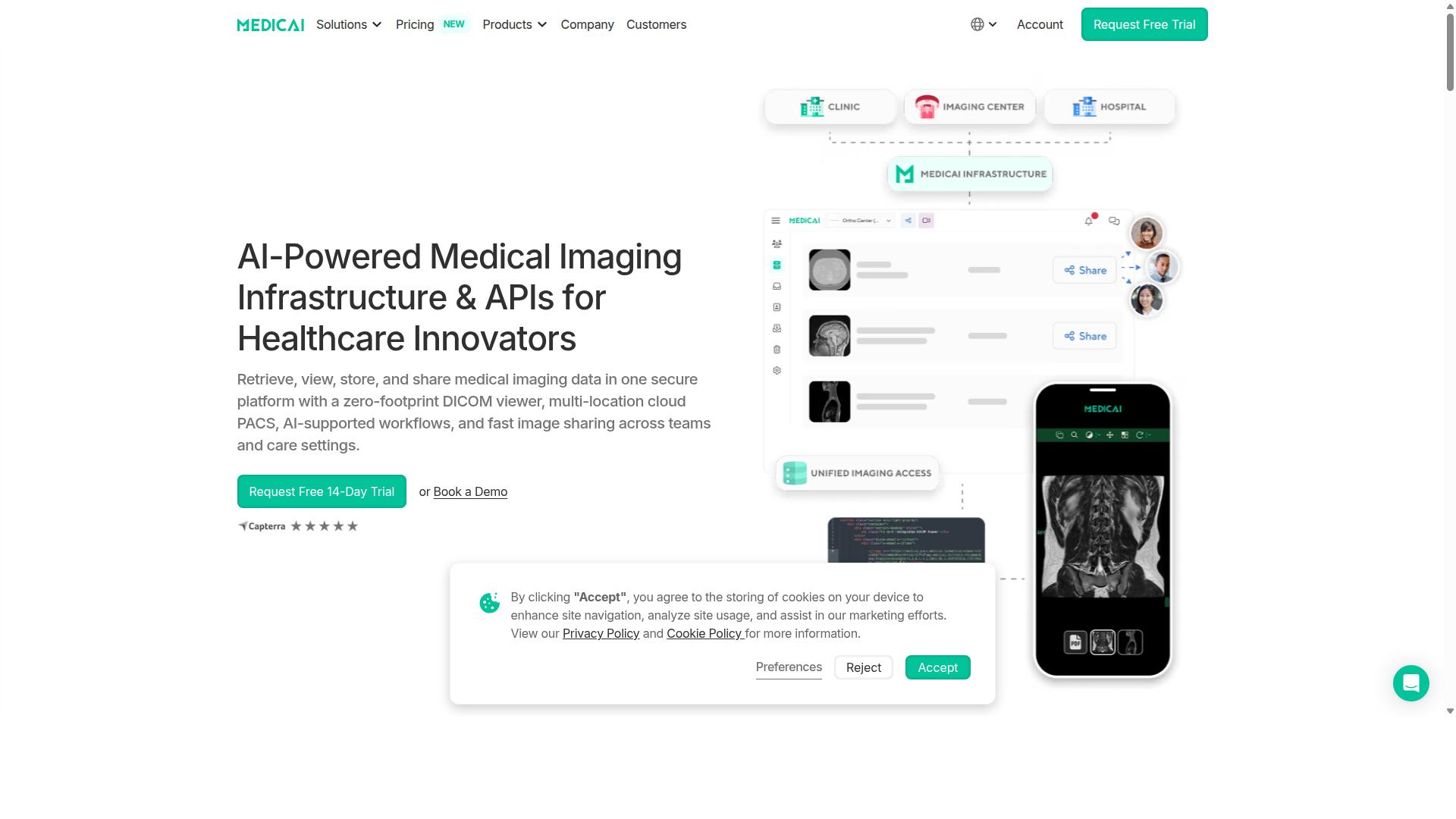
Medicai is a cloud-based medical imaging platform that enables healthcare providers to retrieve, view, store, and share imaging data in one secure environment.
The platform includes a zero-footprint DICOM viewer that requires no software installation on local computers.
Multi-modality support allows clinicians to work with CT, MRI, X-ray, ultrasound, and other imaging formats in the same interface.
Global accessibility means authorized users can access studies from any location with an internet connection, supporting both on-site staff and remote specialists.
Medicai processes over 1 million studies each year, showing its capacity to handle enterprise-level imaging workloads across different healthcare settings.
The platform maintains HIPAA and GDPR compliance, ensuring patient data remains protected under strict regulatory standards during storage and transmission.
These capabilities position Medicai as an Imaging Infrastructure as a Service solution that modernizes radiology workflows while maintaining interoperability with existing hospital systems.
The Competitors at a Glance
This overview provides concise profiles of the three competing vendors.
Each vendor takes a distinct approach to enterprise imaging and diagnostic viewing. Their positioning reveals different priorities around deployment models, target markets, and integration strategies.
Intelerad, ProtonPACS, and Sectra deliver varying degrees of cloud and web-based capabilities. Organizations evaluating these options must weigh how each platform addresses modern radiology workflow demands and zero-footprint requirements.
What Is Intelerad?
Intelerad offers enterprise imaging and workflow solutions for radiology groups.
The company positions itself as a hybrid vendor that combines cloud services with on-premises infrastructure. This approach targets large health systems that require both scalability and existing IT investments.
Intelerad focuses on enterprise-wide medical imaging platform deployments across multiple facilities. Their solutions emphasize consolidated workflows for complex radiology environments.
Health systems evaluating Intelerad typically need robust image distribution capabilities across broad networks. The vendor's hybrid model appeals to organizations maintaining legacy systems alongside newer cloud deployments.
What Is ProtonPACS?
ProtonPACS is a radiology-focused PACS solution serving imaging centers and hospitals.
The vendor emphasizes straightforward deployment processes for facilities seeking turnkey implementations. This approach reduces complexity for organizations without extensive IT resources.
ProtonPACS integrates with existing EMR and RIS systems commonly found in imaging environments. Healthcare facilities often consider this solution when prioritizing simplified installation over extensive customization options.
The platform serves both standalone imaging centers and hospital radiology departments. Organizations choose ProtonPACS when they require reliable PACS functionality without complex infrastructure management.
What Is Sectra?
Sectra provides enterprise imaging solutions across radiology, pathology, and cardiology.
The company operates as a global vendor with modular vendor neutral archive capabilities. Large academic medical centers represent a significant portion of their customer base.
Sectra's enterprise imaging approach spans multiple clinical specialties beyond traditional radiology. Academic institutions often select this platform when they require coordinated imaging across diverse medical departments.
Healthcare systems considering Sectra typically need solutions that address complex multi-specialty workflows. The vendor's presence in academic centers reflects their focus on advanced diagnostic viewing environments.
What Is Medicai for Zero-Footprint Diagnostic Viewing?
Medicai's zero-footprint viewer delivers full diagnostic capabilities directly in any modern browser. The platform eliminates desktop software installation while maintaining the performance clinicians expect from traditional workstations. No local client setup means faster deployment across hospitals and imaging centers.
WADO-RS streaming allows images to load progressively without full study downloads. This approach reduces bandwidth demands while preserving diagnostic quality. Clinicians can begin reviewing studies almost immediately, regardless of study size or network conditions.
3D reconstruction creates volumetric views from standard acquisitions. The feature supports multiple modalities without additional software. Users access these tools through the same browser interface used for regular viewing.
Hanging protocols arrange images consistently according to user preferences. The system saves layouts and applies them automatically when similar studies arrive. This standardization reduces setup time between cases.
Mobile access extends the same diagnostic tools to tablets and smartphones. The interface adapts to smaller screens while maintaining measurement accuracy and image quality. Practitioners can review urgent studies from any location with internet connectivity.
Medicai processes 50 million API transactions annually. This volume reflects reliable performance across multiple healthcare environments. The infrastructure supports both routine workflows and high-volume imaging centers.
Features Compared
This section contrasts the viewing performance and infrastructure backbone of each platform.
Zero-footprint diagnostic viewing has become essential for modern radiology workflows. Intelerad, ProtonPACS, Sectra, and Medicai each offer web-based solutions that eliminate the need for local software installation. Performance and security standards vary significantly across these platforms.
Understanding these differences helps healthcare organizations select the right medical imaging platform for their specific requirements. The following comparisons focus on publicly documented capabilities and verified specifications.
Zero-Footprint Viewing Performance
Performance metrics reveal how quickly each viewer renders studies without local installs. Load times and modality support directly impact clinical productivity and diagnostic efficiency across different healthcare settings.
Most enterprise imaging platforms support standard CT, MRI, and X-ray modalities through their zero-footprint viewers. Advanced tools like 3D reconstruction and hanging protocols require additional processing power that varies between vendors.
Medicai processed 300k+ visualizations of DICOM studies in the last year, demonstrating substantial real-world usage across clinical environments. The platform supports multi-modality viewing with standard 3D tools and flexible hanging protocols for various diagnostic workflows.
Competitors typically offer comparable modality support and 3D capabilities, though implementation details and performance optimization differ across platforms. Bandwidth optimization and lossless compression techniques help maintain viewing quality across different network conditions.
Study sharing capabilities and referring physician portals vary in their responsiveness and user experience. Mobile access options depend on each platform's approach to responsive design and bandwidth management.
Cloud Infrastructure & Security
Security and compliance determine whether a zero-footprint solution can handle regulated clinical data. Healthcare organizations must evaluate HIPAA compliance, data encryption standards, and uptime guarantees before deployment decisions.
Most established vendors maintain compliance with healthcare data protection regulations. Medicai follows HIPAA and GDPR compliance requirements along with OWASP security guidelines. The platform holds FDA and CEE clearance for its viewers.
Cloud infrastructure partnerships provide the foundation for reliable medical imaging platform performance. Medicai maintains partnerships with Microsoft Azure, AWS, and Hetzner to ensure geographic redundancy and scalable resources for enterprise imaging needs.
Other vendors follow similar compliance frameworks, though specific certifications and partnership details vary. Regular security audits and penetration testing represent standard practices across the industry for protecting patient imaging data.
API connectivity and integration capabilities support HL7 interfaces and FHIR integration requirements common in modern healthcare IT environments. These connections enable seamless data exchange between PACS systems and existing EMR workflows.
Pricing Compared
Transparent pricing lets decision-makers forecast total cost of ownership. Most enterprise imaging platforms publish little detail about their pricing models, leaving buyers to request quotes and negotiate each component separately.
Medicai publishes clear monthly tiers that include storage limits and user counts. The Starter plan costs $249 per month for 500 GB of cloud storage with unlimited user accounts and no connected locations. The Standard plan costs $749 per month for 2 TB of cloud storage with unlimited user accounts and one connected location.
Yearly plans save 15 percent. Customers pay $209 per month for Starter or $639 per month for Standard when billed annually. Enterprise customers receive custom storage, multiple connected locations, and multiple external locations with custom pricing.
Competitors such as Intelerad, ProtonPACS, and Sectra require direct quotes for comparable details. Their pricing structures typically involve separate fees for storage, user seats, and connected sites, making total cost calculations more complex during procurement.
Medicai includes a one-time $1,000 DICOM Gateway setup fee per location. Per-study pricing is available for enterprise customers. A 14-day trial of Starter features starts immediately without a credit card. Refunds are not offered for partial periods.
Who Should Choose Medicai
Certain provider profiles gain the most from Medicai's zero-footprint architecture. Multi-site imaging centers and specialty groups find the platform especially useful when they need to share studies instantly across locations.
These organizations often struggle with delayed image access, vendor lock-in, and complicated workstation setups. A web-based diagnostic viewer removes those barriers by letting clinicians open studies from any browser.
Orthopedics, neurology, and oncology practices benefit when referring physicians need immediate study views without installing software. The same applies to networks that coordinate care across multiple locations.
Workflow pain points solved by this approach include slow image transfers, limited mobile access, and inconsistent viewer performance. A cloud-based medical imaging platform keeps studies available without local hardware requirements.
Clinical teams that rely on study sharing across different EMR systems also see advantages. Tumor boards, clinical trials, and medical education groups can review cases without extra IT overhead.
Virtual care providers and teleradiology services gain flexibility when they work across multiple facilities. The platform supports these use cases through its zero-footprint viewer design.
Patient portals add another layer of value by giving patients direct access to their images. This reduces administrative requests while maintaining HIPAA compliance standards required in modern practice.
Final Verdict
The Final Verdict weighs each platform's fit for zero-footprint diagnostic viewing. Organizations seeking a browser-based solution must balance compliance features, global reach, and long-term costs when choosing their medical imaging platform.
Intelerad, ProtonPACS, and Sectra each deliver established enterprise imaging capabilities. Their solutions serve large health systems with complex radiology workflow requirements and existing infrastructure investments.
Medicai stands apart through its documented scale and transparent approach. The platform maintains 1.7M+ studies in storage and processes 50M+ API transactions yearly, demonstrating proven reliability for multi-site deployments.
Global availability allows clinicians across borders to access diagnostic images without geographic restrictions. This capability supports international tumor boards and cross-border patient care scenarios where traditional systems often face limitations.
Organizations prioritizing compliant zero-footprint viewing find Medicai's HIPAA and GDPR compliance paired with FDA/CEE cleared viewers provides regulatory confidence for diagnostic work. The OWASP security guidelines add another layer of protection for sensitive imaging data.
Cost transparency remains a key differentiator. While competitors often require lengthy contract negotiations, Medicai's model allows organizations to understand total ownership costs upfront without hidden fees or extended procurement cycles.
For healthcare systems focused on web-based radiology and efficient image distribution, Medicai offers the combination of verified scale, regulatory alignment, and pricing clarity that modern enterprises require.
Recommended Resources: